HIV and STI testing: where, when and how to get tested
Definition : Getting tested means checking, with a blood test, a swab or a rapid test, whether you have HIV or another STI; for men with several partners, the recommended rhythm is every 3 months.
- Keywords
- STI testing, HIV test, self-test, rapid test, CeGIDD, Mon test IST
- Topics
- Sexual Health & Prevention
- Updated
Why get tested regularly?
Most STIs cause no symptoms, especially in the throat and anus. HIV can stay silent for years. Testing lets you get treated early (syphilis, gonorrhoea and chlamydia are cured with antibiotics), avoid passing infections on unknowingly, and prevent serious complications. In France, about 9,700 people were living with HIV without knowing it at the end of 2024, according to Santé publique France.
How often should you get tested?
The recommendations shared by Sexosafe (Santé publique France) are simple:
- every 3 months (HIV + STIs) if you have several partners a year;
- at least once a year otherwise;
- and also whenever you have symptoms, after a risk, or if a partner tells you they have an STI.
If you are on PrEP, the 3-monthly check-up (HIV, STIs, hepatitis C, kidney function) is part of the follow-up.
Where can you get tested in France?
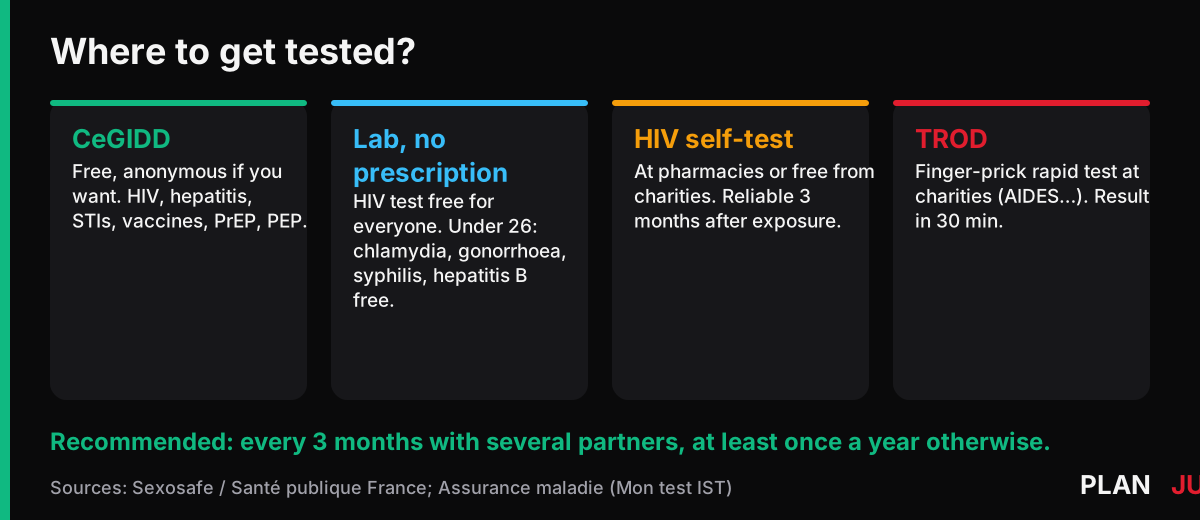
CeGIDD clinics
CeGIDD (free information, testing and diagnosis centres) test for HIV, hepatitis and STIs free of charge, anonymously if you ask. They can also treat, vaccinate and prescribe PrEP or PEP. See our CeGIDD guide.
Labs, without a prescription
- HIV: lab test without prescription and without paying upfront, for everyone.
- “Mon test IST”: since 1 September 2024, under-26s can walk into a lab, with no prescription or appointment, and get free testing for chlamydia, gonorrhoea, syphilis and hepatitis B. Over 26, these tests without prescription are still possible but only partly reimbursed.
Santé publique France notes that tests without prescription already made up 20% of HIV tests in 2024.
Your GP
Your doctor can prescribe the whole check-up. Mention your practices (oral sex, anal sex, rimming): that determines the throat and anal swabs, which are essential for men who have sex with men.
Self-tests and rapid tests
- HIV self-tests are sold in pharmacies or given free by charities. One drop of blood from a fingertip, result in 15 to 20 minutes.
- Rapid tests (TROD) are done by charities such as AIDES, often with a chat.
These rapid tests are only reliable 3 months after the last risk, and a positive result must always be confirmed by a blood test.
What does a full check-up include?
For a man who has sex with men, a “full” check-up usually includes:
- a blood test: HIV, syphilis, hepatitis B and C (and A if you are not vaccinated);
- swabs (urine, throat, anus) for gonorrhoea and chlamydia, which you can often take yourself.
Sexosafe stresses that STIs caught through oral sex or rimming are only detected by throat and anal swabs. A urine test alone is not enough.
What if the result is positive?
Don’t panic. Bacterial STIs are treated in a few days. For HIV, treatment started early allows a normal life (see after an HIV diagnosis). Tell your recent partners so they get tested too: that is how transmission chains are broken.
How long after a risk should you test?
It depends on the test and the infection: 6 weeks for a lab HIV test, 3 months for a self-test or rapid test, 2 days to 3 weeks for bacterial STIs. Details in our article on the window period. And if the risk was less than 48 hours ago, you don’t need a test: you need PEP.
Informational article based on official sources. It does not replace medical advice: if in doubt, if you have symptoms or took a risk, see a health professional or a sexual health clinic.
Sources
Figures and recommendations checked against:
- Santé publique France (Sexosafe) — Dépistage : où, quand et comment ?
- Santé publique France (Sexosafe) — IST : se protéger, se dépister, se soigner
- Sida Info Service — Mon test IST, le dépistage facile des IST et du VIH
- Sida Info Service — Tout savoir sur le TROD VIH
- Santé publique France — HIV and bacterial STIs in France. 2024 report (23 October 2025)