Window period: how long to wait for a reliable HIV or STI test?
Definition : The window period is the time between infection and the moment a test can detect it: 6 weeks for a lab HIV test in France, 3 months for a self-test or rapid test.
- Keywords
- HIV test timing, HIV test 6 weeks, self-test 3 months
- Topics
- Sexual Health & Prevention
- Updated
What is the window period?
When a virus or bacterium enters the body, it is not detectable straight away. The infection has to “settle” and the body has to produce antibodies, or the virus has to be present enough to be measured. That delay is the window period. During it, a test can be negative even though you are infected, and you may already be infectious.
How long for a reliable HIV test?
According to Sexosafe (Santé publique France) and Sida Info Service:
| Test | Reliable negative result… | Where? |
|---|---|---|
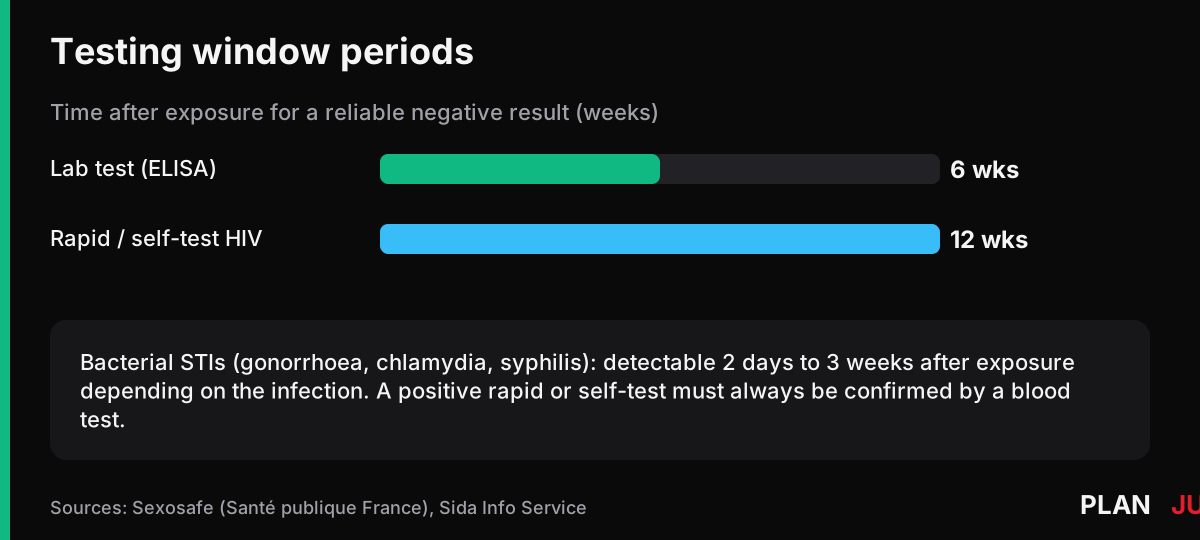
| Lab test (4th-generation ELISA) | 6 weeks after exposure | Lab (no prescription in France), clinic, doctor |
| Rapid test (TROD) | 3 months after exposure | Charities (AIDES…), clinics |
| HIV self-test | 3 months after exposure | Pharmacy, charities |
A lab test can sometimes detect infection from 15 days, but only the 6-week result is conclusive. WHO mentions a window of about 28 days for the most sensitive tests: when in doubt, go by the French timings above.
A positive result on a rapid or self-test is not a diagnosis: it must always be confirmed with a blood test.
What about other STIs?
For bacterial STIs (gonorrhoea, chlamydia, syphilis), Sexosafe says they can be detected 2 days to 3 weeks after exposure depending on the infection. In practice:
- gonorrhoea and chlamydia (throat, anal, urine swabs): a few days to 2 weeks;
- syphilis (blood test): about 3 weeks, sometimes longer;
- hepatitis B and C: several weeks; the doctor will tell you when to retest.
If you have symptoms (discharge, burning, a spot, a sore), don’t wait for the window to end: see a doctor straight away (see STI symptoms).
What to do during the window period?
- If the risk was less than 48 hours ago: go to an emergency department or sexual health clinic for PEP. Testing comes later.
- Protect your partners: condoms or PrEP, especially if you have signs of acute infection (fever, rash, swollen glands).
- Take a first test if you want (it tells you about older risks), then test again when the window closes.
I’m on PrEP: does it change anything?
PrEP can delay HIV detection if infection happens. That is one more reason to stick to testing every 3 months and to the tests required before restarting PrEP after a break. With injectable PrEP, follow-up includes suitable tests before each injection.
Practical questions
Negative test at 4 weeks — am I in the clear? Not yet: repeat a lab test at 6 weeks (or a self-test at 3 months).
Do I need to fast? No, not for HIV or STI tests.
Who can I talk to? In France, Sida Info Service on 0 800 840 800, free and anonymous.
Informational article based on official sources. It does not replace medical advice: if in doubt, if you have symptoms or took a risk, see a health professional or a sexual health clinic.
Sources
Figures and recommendations checked against:
- Santé publique France (Sexosafe) — Dépistage : où, quand et comment ?
- Sida Info Service — Tout savoir sur le TROD VIH
- Sida Info Service — Quand faire un test de dépistage du VIH ?
- World Health Organization (WHO) — HIV and AIDS – fact sheet (updated 27 July 2026)