PEP (TPE): the emergency treatment after an HIV exposure
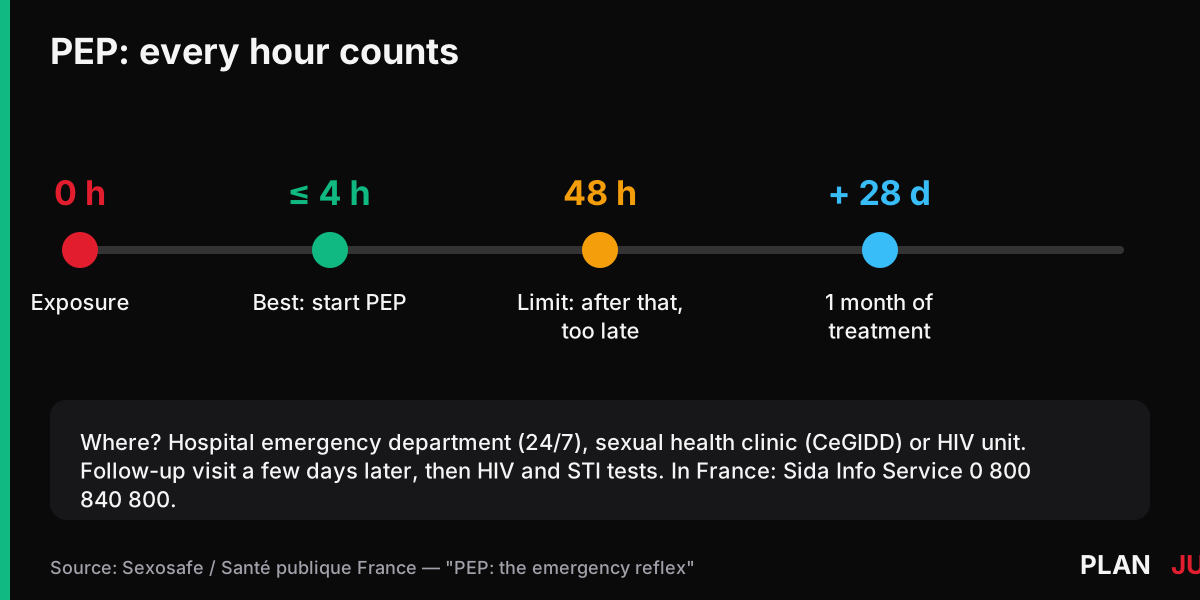
Definition : PEP (post-exposure prophylaxis, TPE in French) is emergency anti-HIV treatment best started within 4 hours and no later than 48 hours after exposure, then taken for one month.
- Keywords
- PEP, TPE, post-exposure prophylaxis, HIV, emergency
- Topics
- Sexual Health & Prevention
- Updated
What is PEP?
PEP (post-exposure prophylaxis, TPE in French) is a combination of anti-HIV medicines taken after exposure to the virus to stop it from taking hold. It is an emergency treatment: Sexosafe (Santé publique France) calls it “the emergency reflex”.
How quickly must it be started?
- Ideally within 4 hours of the exposure;
- no later than 48 hours.
The earlier it starts, the better it works. After 48 hours it is no longer offered in France: you then need to get tested (see window period).
In which situations?
Sexosafe lists in particular:
- anal sex without a condom (condom broke or slipped, stealthing, unprotected sex) with a partner of unknown status or HIV-positive without an undetectable viral load;
- oral sex with ejaculation when the partner has a high viral load (over 1,000 copies/mL);
- doubts about your PrEP (missed pills) or your partner’s treatment;
- sharing syringes or injecting equipment (slamming);
- sexual assault (see what to do after an assault).
Sexosafe offers a quick, anonymous questionnaire to help decide whether to go to A&E. When in doubt, go: the doctor makes the assessment.
Where to get PEP?
- the hospital emergency department, 24/7;
- HIV units (infectious diseases);
- some CeGIDD sexual health clinics, during opening hours.
In France, Sida Info Service (0 800 840 800) can tell you the nearest place. If possible, come with your partner or their HIV status: it helps the doctor decide.
How does treatment work?
- On day one you get a 2–3 day starter pack, dispensed at the hospital or a pharmacy.
- A follow-up visit a few days later reviews test results and how you are coping.
- The full course lasts one month, taken every day without missing doses.
- Tests (HIV, hepatitis B and C, syphilis, chlamydia, gonorrhoea) are done at the start and during follow-up.
Side effects are common but temporary: tiredness, nausea, stomach ache, diarrhoea, headache. Don’t stop without medical advice.
Am I protected during PEP?
Not your partners: Sexosafe points out that taking PEP does not stop you transmitting HIV if infection happened anyway. Use condoms until the final test result.
And afterwards?
If you needed PEP, it may be time to think about PrEP: you can often switch straight from PEP to PrEP at the end of the month, after a negative test. Ask the doctor following you.
Informational article based on official sources. It does not replace medical advice: if in doubt, if you have symptoms or took a risk, see a health professional or a sexual health clinic.
Sources
Figures and recommendations checked against:
- Santé publique France (Sexosafe) — TPE : le réflexe d'urgence après une exposition au VIH
- Santé publique France (Sexosafe) — Devez-vous prendre un TPE ? (questionnaire)
- Santé publique France (Sexosafe) — Santé sexuelle : bienvenue dans les CeGIDD
- World Health Organization (WHO) — HIV and AIDS – fact sheet (updated 27 July 2026)